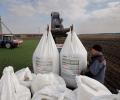
For the first time, the government is likely to dip into the Oil Industry Development Fund (OIDF) to finance part of its fertiliser subsidy programme for 2025-26, according to official sources. The finance ministry has accounted for Rs 23,000 crore in the FY26 Budget as net additional resources to be drawn from dedicated reserve funds, including the OIDF, the Agriculture Infrastructure and Development Fund, and the Universal Service Obligation Fund.

Two of the three strikes are related to the gig economy, a centrepiece of the new labour Codes.

Finance Minister Nirmala Sitharaman will present her 8th straight Budget and all eyes will be on the much-expected tax relief for the middle class. Sitharaman had in her first Budget in 2019 replaced the leather briefcase -- which had been in use for decades for carrying Budget documents -- with a traditional 'bahi-khata' wrapped in red cloth.

The Pakistan Cricket Board (PCB) could face massive financial losses if the ICC's all-powerful governing board decides to penalise them for refusing to play the T20 World Cup match against India on February 15 in Colombo.

In her Budget speech, Finance Minister Nirmala Sitharaman on Tuesday underlined the need for collaboration between the Centre and states to take up the next-generation reforms covering land, labour, capital and entrepreneurship. As far as revenue share goes, the government has projected to give about 32.5 per cent of central taxes to states during FY25, against the 15th Finance Commission's recommendation of 41 per cent, according to the Union Budget estimate.
Defence expenditure was pegged at 1.4 per cent of GDP in the Budget for 2025-26 but it may widen, depending on tensions between India and Pakistan.

'In such a scenario, Iran could proclaim itself victor, rebuild, re-enforce its diminished regional proxies to further destabilise neighbouring nations and take control of the Persian Gulf and Strait of Hormuz.'

Even as the benchmark and broader indices were down sharply on Monday due to escalating tensions in West Asia, the Nifty Defence index ended the session in the green.

The government may save over Rs 70,000 crore (Rs 700 billion) on capital and revenue expenditure allocated towards new schemes in the FY25 Budget that are yet to be implemented.

'There is no immediate threat to the government, and they would prefer the growth agenda.'

Net direct tax collection grew 13.13 per cent to over Rs 21.26 lakh crore so far this fiscal aided by by higher advance tax mop up, government data showed on Monday. During the year, the government collected Rs 10.44 lakh crore from four instalments of advance tax as against Rs 9.11 lakh crore in the previous fiscal, registering a growth of 14.62 per cent.

The Centre's fiscal deficit at the end of the first seven months of financial year 2024-25 touched 46.5 per cent of the full-year target, government data showed on Friday. In absolute terms, the fiscal deficit -- the gap between government's expenditure and revenue -- was at Rs 7,50,824 crore during April-October period, according to data released by the Controller General of Accounts (CGA). The deficit stood at 45 per cent of the Budget Estimates (BE) in the corresponding period of 2023-24.

Analysts and economists have hailed the fiscal projections in the interim Budget, saying the lower fiscal deficit forecast shows that the government, even in an election year, is serious about fiscal consolidation and that the numbers look achievable. According to Devendra Kumar Pant, the chief economist at India Ratings, the two broad themes of the interim Budget are fiscal consolidation and stepping up focus on agriculture/rural to course correct, to some extent, the differential benefits of the ongoing economic growth that's tilted in favour of upper-income bracket/urban households. The projected fiscal deficit numbers for FY24 and FY25 suggest that the government is serious about achieving the fiscal consolidation path of 4.5 per cent fiscal deficit by FY26, and given the nominal GDP growth assumption and revenue buoyancy, the target appears plausible, Pant said in a note.

'Based on the joint statement, a formal agreement will be drafted, which may take a month or month-and-a-half to finalise. We aim to sign the formal agreement by mid-March.'

Uttar Pradesh, Gujarat and Odisha budgets maintain revenue surpluses despite welfare schemes while Rajasthan and West Bengal face high debt, fiscal deficits and low capital outlay.

After years of rapid expansion, the Centre's capital spending growth eases as private investment shows early signs of revival, points out A K Bhattacharya.

Supported by strong buoyancy in public sector capital expenditure (capex), growth in infrastructure investment is expected to accelerate in 2025-26 (FY26) compared to 2024-25 (FY25), according to the First Advance Estimates of gross domestic product (GDP) for FY26 released by the National Statistics Office (NSO) on Wednesday.

Paraphrasing Abraham Lincoln, Finance Minister Nirmala Sitharaman on Sunday described the Union Budget as "by the people, for the people, of the people", and said Prime Minister Narendra Modi was fully behind the idea to cut taxes for the middle class but it took time to convince the bureaucrats. "We have heard the voice of the middle class" who had been complaining about their aspirations not being met despite being honest taxpayers, she told PTI in an interview.

10 largecaps stocks which stand to gain from the Budget.

Mardaani 3 opens better than its previous installments.
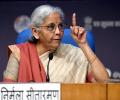
The Budget 2025-26 meets the expectations of fiscal consolidation, maintaining capital expenditure, and boosting consumption through tax cuts.

The Centre's fiscal deficit stood at 17.9 per cent of the full-year target at the end of June, according to data released by the Controller General of Accounts (CGA) on Thursday. It was at 8.4 per cent of Budget Estimates (BE) of 2024-25 in the first three months of the previous financial year.

With discretionary spending still under pressure, the information technology (IT) services industry continued to face an uncertain demand environment in the third quarter of 2025-26 (Q3FY26).
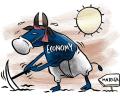
After a gap of more than three years, the central government has agreed to resume the Mahatma Gandhi National Rural Employment Guarantee Act (MGNREGA) works in West Bengal with immediate effect, but subject to mandatory adherence to stringent conditions. These include a prohibition on any work valued at more than 20 lakh, compulsory 100 per cent electronic know-your-customer (eKYC) verification of all workers, and mandatory pre-estimation field visits for all works before they are undertaken.
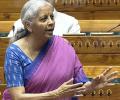
The Lok Sabha on Tuesday passed the Finance Bill 2025, along with 35 government amendments, including one that abolishes a 6 per cent digital tax on online advertisements.

'The global situation is not very good.'

Cognizant reported a significant increase in net income for the December quarter, driven by AI efficiencies and strong performance in the financial services sector. The company also announced a major deal and provided guidance for the upcoming year.

CAG warns most states of fiscal imprudence as March spending overshoots limits, with key departments exhausting large portions of budgets in the last month of FY24.

The question is no longer whether the war will expand. It has. The next few days will tell us whether the war stabilises around Hormuz or whether the Strait itself becomes the trigger for a far larger rupture. What to watch for over the next 48 hours is simple: Any move by the US toward direct naval control of the Strait; any credible Iranian attempt to disrupt or mine shipping lanes and, critically, whether energy infrastructure in the Gulf continues to be targeted.If those lines are crossed in tandem, the war will no longer be containable within the region.

Union Finance Minister Nirmala Sitharaman on Tuesday said the fiscal deficit for 2024-25 is estimated at 4.9 per cent of GDP.

'Compare the new slabs with the previous years to understand if your tax liability will increase or decrease after the Budget.'

This would imply a 29 per cent year-on-year rise, significantly lower than growth rates seen in recent years.

The central government's fiscal deficit fell to 0.8 per cent of the full-year target at the end of May, mainly due to a whopping Rs 2.69 lakh crore dividend received from the Reserve Bank of India. The fiscal deficit, or gap between the government's expenditure and revenue, had touched 11.9 per cent of the Budget Estimates (BE) for 2025-26 or Rs 1.86 lakh crore in April.

The Budget estimate of fiscal deficit for the next financial year has been underestimated by nearly 0.9 percentage point of Gross Domestic Product, or about Rs 51,000 crore. This is because the estimates for revenue collections in the Interim Budget for 2009-10 do not reflect the full impact of the duty concessions announced by the government since December 2008. The Budget estimate for fiscal deficit in 2009-10 put it at 5.5 per cent of GDP.

Trade deals ease risks for Indian equities, but weak demand and stretched valuations raise questions over whether optimism -- especially in smallcaps -- can turn into a sustained bull run, points out Debashis Basu.

The Rural Development Ministry has been allocated Rs 1.88 lakh crore in the Union Budget for 2025-26, around 5.75 per cent more than the allocation in the previous budget.

India and the US are expected to sign the first phase of a bilateral trade agreement by mid-March, which will result in the US lowering import duties on Indian goods. India will then begin reducing import duties on certain US goods.
India and the US are expected to sign the first phase of a bilateral trade agreement by mid-March, which will result in the US lowering import duties on Indian goods. India will then begin reducing import duties on certain US goods.

Experts say Indian Railways must grow its share in the freight market to remain financially sustainable.

Fiscal deficit for 2021-22 worked out to be 6.71 per cent of the gross domestic product (GDP), lower than 6.9 per cent projected by the Finance Ministry in the revised Budget Estimates, according to government data released on Tuesday. Unveiling the revenue-expenditure data of the Union government for 2020-21, the Controller General of Accounts (CGA) said that the fiscal deficit in the absolute terms was be Rs 15,86,537 crore (provisional).
